Failed romance has a way of feeling personal. If someone loses interest, acts brazenly selfish, or royally screws up, it is hard not to take that personal. Being with someone romantically inherently comes with a level of vulnerability and trust. When things end, it feels like a waste of time and emotion, and most of all, it hurts. Blame is a natural reaction.
So what is Narcissism?
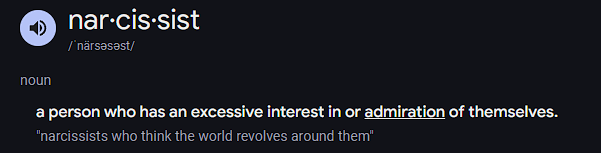
Generally speaking in simple dictionary definitions, Narcissism is selfishness in action, but tied to yourself and your own admiration. That isn’t really what we are saying when we call someone a narcissist, though.
As we move to a more phycological definition, narcissism is described more specifically at a state of being. “Selfishness, involving a sense of entitlement, a lack of empathy, and a need for admiration, as characterizing a personality type.” So, a selfish person that needs admiration.
Finally, we land on Narcissistic Personality Disorder (NPD). According to the Mayo Clinic “Narcissistic personality disorder is a mental health condition in which people have an unreasonably high sense of their own importance. They need and seek too much attention and want people to admire them. People with this disorder may lack the ability to understand or care about the feelings of others. But behind this mask of extreme confidence, they are not sure of their self-worth and are easily upset by the slightest criticism.”
Now all these seem to lead to another and we might easily assume that someone who acts narcissistically sometimes, in certain situations, or even with some level of frequency and in certain ways could classify as a narcissist. I have yet, in my time on this earth, to meet anyone that hasn’t acted narcissistically at some point or another. With that being said it is only estimated that 1% of the population actually qualifies for a diagnosis of NPD. Though some studies report a range of up to 6%, those seem to be outliers. Some studies suggest men are slightly higher recipients of this diagnoses, while many others state little to no gender difference and most all seem to lean towards narcissists being made, not born.
So Could They Really Be A Narcissist?
So if you can’t tell, I am not a psychiatrist, so I won’t actually be diagnosing your ex. However, what makes you think that you are so special to land someone in this small percentage of the population? It could simply be your demographics. Narcissistic traits have higher rates in certain age groups, like teenagers and young adults. They also have links with higher social media usage and even higher income. Sound like a large chuck of the dating pool? People of all ages today suffer with side effects of all kinds stemming from lack of communication, connection, and social skills, making it easier for most everyone to come across as selfish and more self- interested.
As therapy culture grips more of society, there is a bit of relief that comes from knowing what ails us, even if it’s other people, is a medical condition, something a pill could help. Not to downplay medical diagnoses, but more to downplay unprofessional opinions. Labeling people as narcissists via your search of symptoms on Web M.D. is not very helpful or accurate. Being selfish or unhappy in a relationship is a pretty common thing and the solutions range from saying “please” to faking your death and moving over seas.
Before you journey down the rabbit hole that is the symptom list of NPD, I may suggest equally considering that the other person has one of these other two possible behavioral traits.
Self Confidence
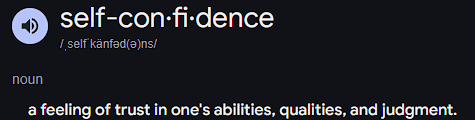
Confidence is often listed as one of most attractive things a person can possess aside from physical attractiveness. Someone who fails exhibit self-confidence is overlooked or viewed as less attractive than someone who is comfortable with themselves and not afraid to show it.
Confidence doesn’t come from one’s self entirely. It comes from experience and accomplishing things, even if that is mastering one’s emotions and expectations. It also comes with it’s own sense of greatness, not grandeur per se, but that feeling of having something worth being proud of.
Self Interest

We all have to put ourselves first to some degree. In most relationships, especially pre-marriage, everyone should have a healthy idea of “what’s in it for me.” This is what keeps you out of bad and draining situations, maybe even the trigger of a breakup, but it is not one-sided. Both parties need some benefit from the relationship, even if it isn’t the same thing. The benefits do not even need to be equal (if you can even determine what “equal” means when it comes to the benefits in a relationship), both parties just need to be getting what they are looking for out of the relationship.
Acting in your own self-interest is often praised as self-respect and an absolute must for self-care. This can’t only apply to your benefit, because if that is the case it sounds a bit… Narcissistic.
The Most Likely Case
Chances are, you didn’t wander into a one-sided relationship with a narcissist. You likely found the wrong person at the wrong time. You both had needs and expectations, goals and priorities that simply did not align. One or both of you were not truly focused on the relationship and communicated effectively. Maybe the intentionality with the relationship was never established. Maybe, just maybe, there was a lot of innocent and aloof selfish behavior coming from emotional immaturity.
These things don’t happen in a vacuum and the signs were likely always there, just ignored or tolerated for whatever reason, love, hope, or naiveté. Bad matches that go on too long hurt, as do miscommunications. This doesn’t make anyone bad, but the hurt can lead to uncharacteristic bad behavior. In a world where the next date can be a swipe away, being good to one another seems to almost be too much work. Maybe that perfect partner that reads your mind and delivers on your every desire effortlessly, because they “just get you” is right around the corner. Your friends will be quick to comfort you with a cliché “you shouldn’t put up with that.” Whatever your crutch, there is an excuse to lean on that can take away your part in the failed relationship, even convincing yourself that the other person is a damaged, irreparable narcissist.
A breakup doesn’t define anyone, even a bad one. Just as a relationship takes two people to make work, incompatibility requires two. Civility, on the other hand, only takes one. Reflection only takes one. Every relationship gives us a once in a lifetime chance to learn about someone else, about ourselves, and a chance to engage in the most intimate of human experiences. No, I don’t mean the sex, but the vulnerability to get close enough to someone and trust them enough to possibly be hurt. To love fully. That is worth the experience. Next time, if you learned anything, you may see the signs of known incompatibilities. You will have strategies to manage the arguments and slights against you. You will know better the traits to look for.
Perhaps, what you saw as narcissism in the end was what attracted you to them in the first place. The confidence, charisma, and perceived competence. Just maybe, that person knew what they wanted and you just weren’t it. Maybe they strung you along because they cared about you enough that they didn’t want to see you hurt. Just maybe, they too, felt like they were in a relationship with a narcissist.
Be good to each other, always be civil, and be happy, especially if your ex does turn out to be a narcissist, because “That’s the best revenge of all: happiness. Nothing drives people crazier than seeing someone have a good fucking life.”
― Chuck Palahniuk