We have all done it. Had the desire to do something, but rationalize ourselves out of it, because we are waiting for the right time. The career move, opening that retirement account, getting married, having kids, and so on. I will spoil things for you. If you are waiting for the right time, it never comes.
The reason that “the right time” will never come is largely in part to the way our brain stores knowledge and solves challenges. As we get older, the way we solve new challenges changes thanks to the concepts of Fluid and Crystallized Intelligence.
Fluid and Crystalized Intelligence.
Fluid Intelligence allows flexible thinking. We take in new knowledge and apply basic knowledge. It helps us to find new and creative ways to approach questions because we work from more of a blank slate of knowledge. When we are young, most of our intelligence is fluid since we encounter more things for the first time. Crystalized intelligence leans on experiences. As we solve problems, we develop knowledge and frameworks that help us quickly recall outcomes and reasoning. It leaves less room for creativity and encourages complacency and rigidity. You wouldn’t want to read the user manual for every different oven you try to turn on, would you? No, you know how most of them work and can apply that knowledge and do the task with minimal effort.
Both types of intelligence are extremely useful, and a balance is needed. Through the first 20 years of our lives, we use an almost equal mix of Fluid and Crystallized intelligence. However, as we age, we acquire more knowledge and experience, leading to a decrease in our fluid intelligence. At the age of 30, we start the noticeable decline. We simply don’t have the same need for flexible problem-solving as we learn more.
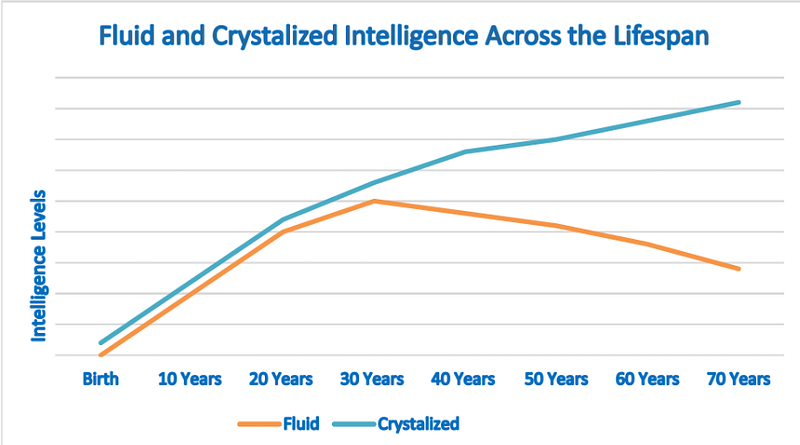
This decline accounts for that feeling we all get where we start to notice that we don’t learn as fast as we used to. We start to have deeper-held beliefs and more rigid habits. Change gets much harder. Sure, you can fight it and prolong the shift, but it is inevitable. Try learning a second language next to a six-year-old, and that will show how powerful this effect can be.
So, knowing that your ability to learn is relatively finite, how does that affect how you think about your life’s trajectory?
We put things off longer these days. Moving out, starting careers, getting married, having kids, etc., are shifting these milestones into times in our lives when our problem-solving abilities are starting to decline. This turns problems that can be solved with creativity into compatibility problems. The question is no longer “How can I make this work?” The question becomes, “How can I make this work within my life as it is?” That shift towards the permanence of mental state.
When we are in our twenties, we can add almost anything to our lives. Insert knowledge, tasks, rules, and frameworks, and build around them. We can more easily change our habits. The older we get, we have to leave space for new things or work hard to force a square peg into a round hole. New things just don’t fit as easy.
Crystalized knowledge is not a bad thing, though in a world that you are supposed to “always be learning,” it can seem that way. Crystalized knowledge leads to much more overall competence and expertise. This is why careers often peak in our forties. We have acquired a wealth of experience and still have a little fluid intelligence left to apply it creatively. Confidently knowing how the world works is insanely valuable. It helps you move through life with less struggle and reduces the taxing task of learning new things all the time.
It’s less about choosing your adventure and more about when to have it.
If you were told that you were not going to be able to learn anything new after the age of 30, how would that change how you planned your life? That is kind of what we are talking about here. Would you spend your life learning to specialized skill that has a 15-year shelf life before becoming obsolete? Would you spend it acquiring a broad knowledge base that can help you stay in conversations longer? Would you spend more of your younger life learning how to be in a relationship or be a parent? All these are skills that require you to acquire, retain, and apply knowledge, which is easier when we are young.
Acquire the right kind of knowledge early, and you can apply it to a career later. Sure, there is a momentum factor, but again, you build your life around the situation you are in. It may be worth noting here that founders in their mid-forties have the lowest rate of startup failures for reasons.
It is a bit like investing for retirement. A dollar invested at 16 can be four times as valuable as a dollar invested at 30 by the time you are ready to cash in. Lots of people will wait until “the right time” to start saving, when they have a career and extra money, forgoing the opportunity of starting early. Better late than never, but the longer you wait, the harder it is.
So what is the most important knowledge you can acquire? If you could direct the curriculum of your younger self, what would you force them to learn while it is easy?
Reid Pierpoint